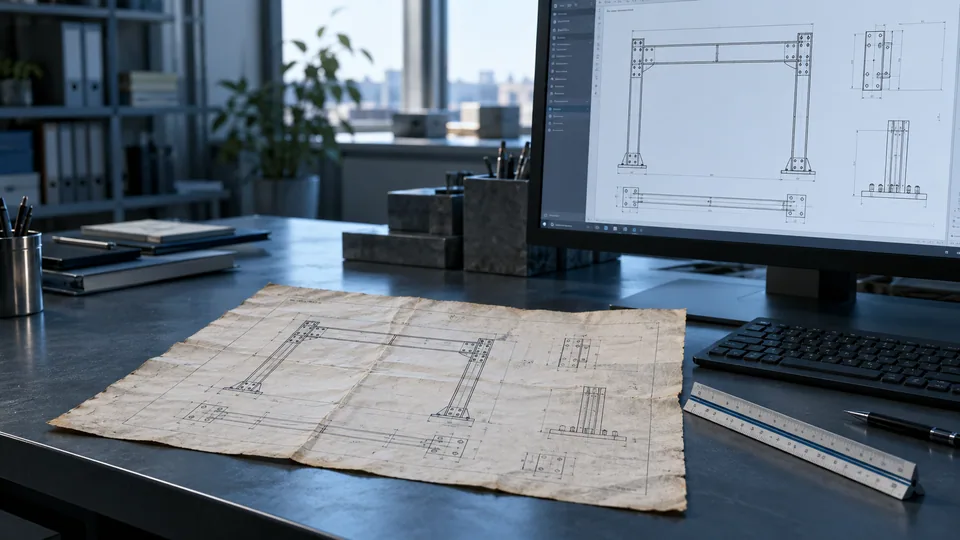
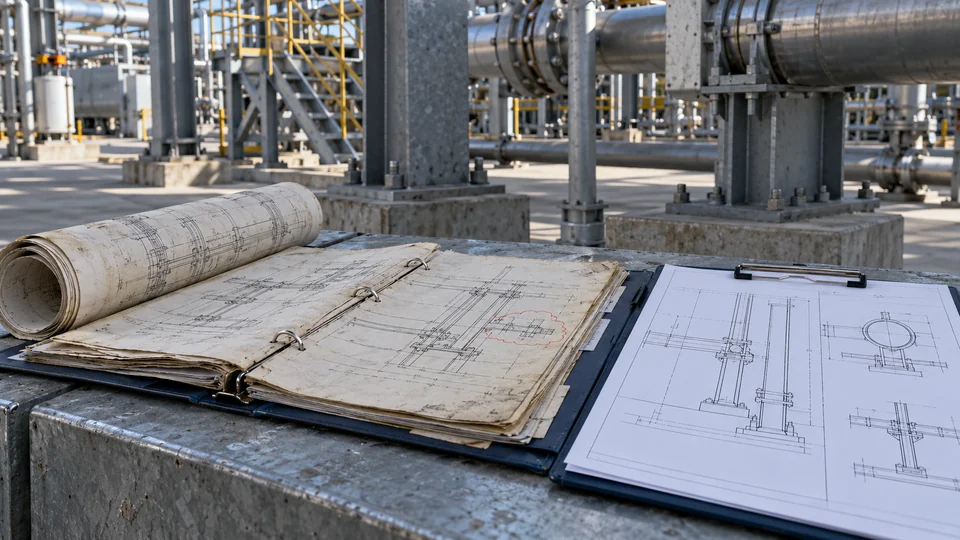
An old plant drawing is not automatically unusable. It may retain useful information about an installation, equipment arrangement or historical modification. The difficulty arises when a project relies on it for a decision without understanding its revision, coverage and relationship to current conditions.
Locate the decision that depends on the record
Start with the proposed work. A maintenance reference, a new support interface and a fabrication package need different information. Identify which decisions depend on the drawing and what confidence those decisions require.
For example, a historical arrangement may help locate the relevant area for an initial discussion. Developing a new connection against that arrangement may require current dimensions and interface information. The existence of a drawing file alone does not establish that it is suitable for both tasks.
Identify the particular equipment, structure or interface involved. This narrows the records that need attention and helps avoid a large archive-cleanup exercise disconnected from the current project. The next decision should guide what needs to be recovered or verified first.
Follow the revision trail
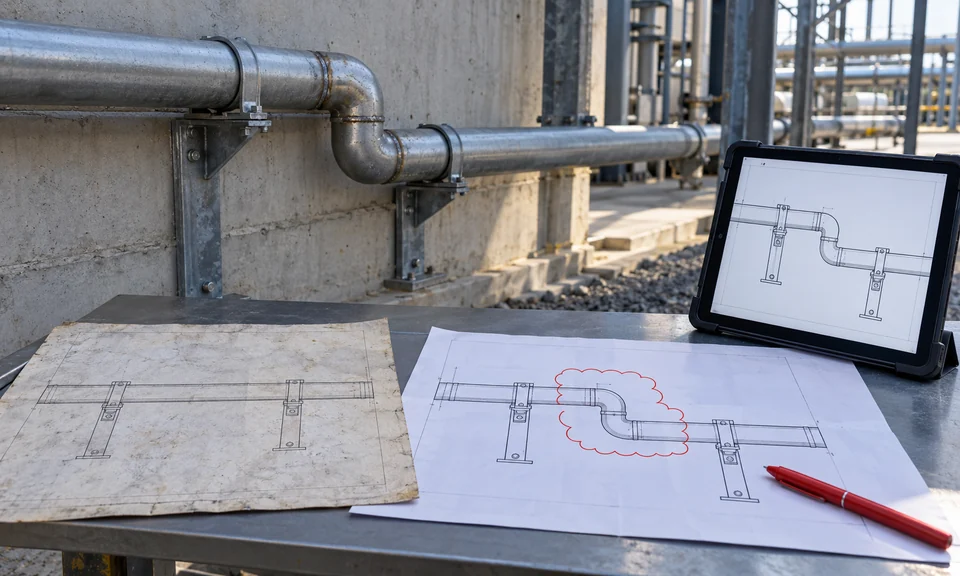
Collect the available drawing numbers, revisions, issue records and relevant markups. Ask which set the site or project team regards as current and what evidence supports that status. Distinguish a working copy, a reviewed package and an issued record through the applicable project controls.
An overwritten filename can hide earlier changes. A printed sheet may predate a modification recorded elsewhere. An editable drawing may be newer than a PDF but still contain unresolved information. Compare the set carefully rather than assuming one file type or recent date makes an item authoritative.
Record contradictions so they can be resolved by the appropriate person. Keeping two competing versions in circulation without an explanation can make later technical work depend on whichever file someone happened to receive.
Understand where repeated work can arise
When the available record does not answer a required question, a team may have to measure, query or investigate the same interface again. If that information is not captured clearly, another team can repeat the exercise during a later package.
The problem may also appear as a clarification loop. A detailer asks about an interface, the response refers to an older sheet, and a later review reveals an unrecorded change. Work developed in the meantime may need revision. These are possible pathways, rather than inevitable outcomes on every project.
Procurement and fabrication discussions can also remain open while material, arrangement or interface information is uncertain. A clean-looking sheet can conceal that uncertainty unless its issue purpose and unresolved items are visible. The appropriate response is to resolve the needed information through the responsible review route.
Separate a poor source from an unverified condition
A damaged scan, difficult-to-edit record or incomplete drawing set is a source-information problem. A mismatch between the record and the installation is a current-condition problem. The same package may contain both, but each needs an appropriate response.
Drawing Reconstruction can develop usable technical documentation from available references within an agreed scope. Rebuilding a drawing does not establish that its geometry is current. As-Built Services addresses the agreed recording and verification context where existing conditions need attention.
The reconstruction decision guide explores source recovery. The as-built verification guide covers verification readiness and limits. This overview helps decide which information problem matters first for the project.
Prioritise by intended use and confidence
Use the table as a discussion aid. It is deliberately qualitative; it is not a safety classification or an engineering risk score.
| Record situation | Why it deserves attention | Practical next question |
|---|---|---|
| Record supports an imminent modification interface | Uncertainty can affect the next technical decision | Which current dimensions and interfaces must be established? |
| Conflicting revisions or unrecorded changes are visible | Different recipients may develop incompatible information | Who resolves the authoritative reference and change history? |
| Source is legible but difficult to revise or reuse | Repeated tracing or interpretation may be required | Is controlled reconstruction justified by the intended output? |
| Record is for archive/reference use only | Its immediate use may be limited | What status and limitations should remain clear to readers? |
Consider modification exposure, record confidence and the need for the next package together. A recent drawing with an unresolved interface may require attention sooner than an older record that is only being archived. The responsible project or site authority should determine operational priorities.
Capture the information once and carry its limits forward
Define the observations or measurements needed and how they will be recorded. Identify the source, date, coverage and relevant reference used for an update. Where something is inaccessible, concealed or unresolved, retain that limitation rather than treating a partial check as complete verification.
If a difference is found, assign a resolution owner and show how the affected views or records will be updated. Coordinate related documents where the change affects them. A useful update should leave the next reader with a clearer information trail.
The UK BIM Framework's Information management according to BS EN ISO 19650 — Guidance Part 2: Processes for Project Delivery, Edition 3, January 2020, discusses information states, revision control and coordination workflows. It provides international reference context, not a DynaStruct certification or a governing instruction for every plant project. The time/rework pathways and prioritisation method here are practical editorial interpretations, not measured outcomes. UK BIM Framework information-management guidance.
Make the next package ready to use
Before a record is relied on for further technical work, confirm:
- Its intended use and the decision it must support.
- The available source set and known revision history.
- Which parts relate to observed current conditions.
- Known changes, conflicting information and inaccessible interfaces.
- Required measurements or additional inputs and who obtains them.
- The person responsible for resolving technical queries.
- The checking, approval and issue route for the updated package.
- How superseded records will be identified at handover.
Document preparation supports clearer decisions, while operational changes and safety-critical decisions remain with the responsible site and engineering authorities. A revised record by itself does not authorise plant modification.
Choose support around the information problem
The appropriate starting point may be source reconstruction, defined as-built recording, or additional Support Services to progress a controlled documentation package. The external drawing-office support guide explains how to brief that work and retain client control.
Explore the Industrial and Mining contexts and How We Work. Share the proposed work, available drawings and known differences through Discuss Your Project. A focused information brief helps DynaStruct assess the appropriate practical support route.